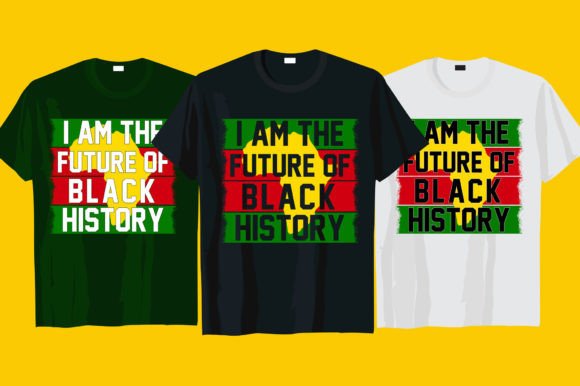
I Am the Future Black History T Shirt: Designing with Purpose
There is a specific weight to typography that carries a message before the viewer even reads the words. When you are dealing with cultural statements like "I Am the Future Black History," the typeface you choose does more than just present text; it sets the emotional tone. This design concept isn't just about a catchy phrase on a hoodie; it is about positioning. It blends modern typography with a deep sense of legacy. For designers, entrepreneurs, and content creators, understanding how to leverage this specific visual style is crucial for creating products that actually resonate with an audience.
The Visual Identity: More Than Just a Phrase
At its core, the "I Am the Future Black History" typography design functions as a statement piece. Visually, it demands a font pairing that balances authority with forward momentum. You are likely looking at a layout that utilizes a heavy display font for the impact words—"Future" and "History"—while potentially using a cleaner sans serif font or a dignified serif font for the connecting words to ensure readability.
The personality of this design is bold and unapologetic. It fits perfectly within the aesthetic of streetwear, but it carries enough sophistication for editorial design or high-end packaging design. If you are working on social media graphics for a campaign, this typography style acts as a visual anchor. It tells the audience immediately that the content is serious, celebratory, and modern. The style suggests a modern typography approach—clean lines mixed with expressive kerning that allows the text to breathe on a canvas, whether that is a digital screen or a cotton t-shirt.
Practical Applications for Print on Demand and Digital Assets
For those in the Print on Demand (POD) space, the versatility of the "I Am the Future Black History" design is a significant asset. Because the design is typographic-first, it adapts well to various substrates. However, application matters. A premium font with high contrast works beautifully on a hoodie or sweater where the fabric texture adds depth. For a mug or a sticker, you need to ensure that the font weight doesn't bleed together at smaller scales.
Here is how you can practically apply this design across your product line:
- Apparel (T-Shirts, Jumpers, Hoodies): The design serves as the focal point. Use a graphic t-shirt approach where the typography is the hero. Ensure the PNG files are high-resolution (300 dpi is standard) to prevent pixelation on large prints.
- Home Goods (Mugs, Pillows): These items require a different consideration for curvature and viewing distance. A script font or handwritten font might be used for accents, but the main message needs the solidity of a block typeface to remain legible.
- Digital Products: If you are selling this as a digital asset, the EPS vector file is your best friend. It allows other creators to scale the design for banners, posters, or web design elements without losing quality.
Typography Strategy and Brand Perception
Choosing a typeface like the one used in this design is a strategic decision for brand identity. In the context of Juneteenth or Black History Month campaigns, the typography signals the brand's values. A heavy, grounded typeface suggests stability and respect for the past, while the forward-leaning composition of "Future" suggests innovation.
When evaluating this for your own projects, consider the font pairing. If you are creating a full campaign, you cannot use the display design for everything. You need a supporting cast. Pair this bold, expressive creative font with a neutral, legible body text—perhaps a geometric sans serif font for digital screens or a classic serif font for printed booklets. This contrast creates a visual hierarchy that guides the viewer's eye. The heavy typography grabs attention, and the cleaner body text delivers the details.
Evaluating the Files for Production
Quality control is non-negotiable. When you download the design files, you are typically receiving a package containing EPS, PNG, and JPEG formats. Here is a checklist for using these design assets effectively:
- Check Scalability: Open the EPS file in a vector editor like Illustrator. Can you scale it up to fit a poster without the edges becoming jagged? This is essential for logo design or large format printing.
- Verify Color Profiles: Ensure the 100% color changeable feature works in your specific software. For printing, you will often need to convert RGB to CMYK, so having a vector file makes this process much smoother.
- Test on Mockups: Before listing the product, place the design on a realistic mockup. Does the typography look good on a dark background? Does it lose impact on a light one? Readability considerations are paramount here.
Ultimately, the "I Am the Future Black History" design is a tool for storytelling. It combines modern typography with cultural significance. By using high-quality files and understanding the principles of visual hierarchy, you can create products that don't just look good, but feel meaningful. Whether you are a small business owner designing merchandise or a crafter making personalized gifts, this typographic style offers a professional, impactful way to honor the occasion.